 3D Printer FYI
A print can contain two dollars of plastic and still be an expensive job. Someone prepared the file, occupied the machine, removed supports, checked the result and answered the message asking whether it could be slightly different.
Start with a cost model, then choose a price. The arithmetic below is a worked example, not current market pricing or a promise of profit.
Define the job boundary
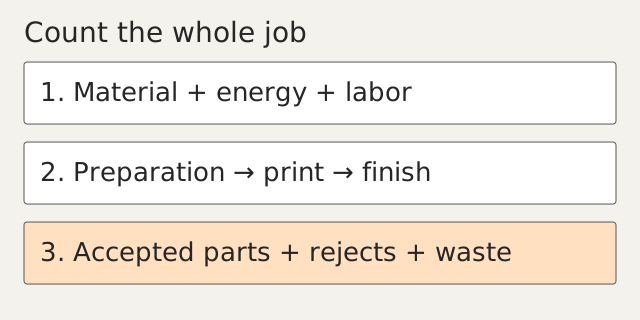
Specify quantity, model revision, material/formulation, finish, inspection, packaging and delivery. State who supplies a printable file and how many design revisions are included. Decide which work happens per order, per batch and per accepted part.
Keep fixed and variable costs distinct. The SBA’s break-even guidance defines the relationship between fixed costs, unit price and unit variable cost; the simple model assumes a sufficiently consistent product or service. It is not a substitute for cash-flow planning. Break-even point
Use the print-cost calculator for its supported cost inputs and the quote calculator for the pricing step. Inspect their omissions before using the totals.
Build the cost in pieces
| Item | Calculation | Check |
|---|---|---|
| Material | Consumed grams / package grams × package price | Include supports and purge; match currency and variant |
| Energy | Measured kWh × tariff per kWh | State equipment and warm-up boundary |
| Machine allocation | Occupied hours × chosen hourly allocation | Disclose what maintenance/depreciation it includes |
| Labor | Hands-on hours × labor rate | Include preparation, finishing and inspection |
| Other direct costs | Consumables, packaging and job-specific services | Avoid counting them again in overhead |
| Rework | Explicit allowance or evidence-based model | Do not invent a universal failure rate |
A power-supply rating is not measured job energy. A printer’s purchase price divided by imaginary future utilization is not an observed machine cost. Both may appear as labeled planning assumptions, but neither should quietly acquire the status of a measurement.
Worked quote: all numbers illustrative
Assume a job consumes 100 g from a 1,000 g package priced at $20. It uses 0.6 kWh at $0.20/kWh, occupies three hours at an assumed $0.60/hour machine allocation, and takes 0.5 hands-on hours at $24/hour. Add $1 packaging and a deliberately assumed $2 rework allowance.
| Item | USD |
|---|---|
| Material | 2.00 |
| Energy | 0.12 |
| Machine allocation | 1.80 |
| Labor | 12.00 |
| Packaging | 1.00 |
| Rework allowance | 2.00 |
| Listed job cost | 18.92 |
The quote example CSV contains these synthetic inputs. Replace them with your own values; it is not an offer or benchmark.
Calculator-reproducible example
The print-cost calculator and quote calculator reproduce the following labeled inputs exactly. They are planning numbers, not a market rate.
Cost inputs: 100 g at $20/kg, 3.00 h, 0.60 kWh, $0.20/kWh, 30 labor minutes at $24/h, machine allocation $1,200 / 2,000 h, $3 consumables (packaging plus a stated rework allowance). Expected result: material $2.00, electricity $0.12, labor $12.00, depreciation $1.80, consumables $3.00, listed job cost $18.92.
Quote inputs on that $18.92 cost: 30% markup, no design fee, no rush, no tax, no shipping. Production price $24.596. The same cost at a 30% margin is $27.02857… Markup and margin still use different denominators.
Markup and margin have different denominators
With listed cost C and selling price P:
- Markup = (P − C) / C.
- Margin on those listed costs = (P − C) / P.
- A markup u gives P = C × (1 + u).
- A target margin m gives P = C / (1 − m).
For $18.92 cost, 30% markup gives $24.596 before rounding. A 30% margin requires about $27.03. If a selling fee takes 5% of revenue and the target margin is 30% after that fee, solve P = 18.92 / (1 − 0.05 − 0.30), or about $29.11. Fixed transaction fees belong in the numerator; the percentage model only covers revenue-proportional fees.
Reject a denominator of zero or less. Rounding, taxes, shipping and platform fee rules need explicit treatment. “Margin” here is on the stated cost boundary; omitted overhead can make it very different from business net profit.
Reprints and capital recovery
If each attempt consumes the same variable cost V and succeeds independently with probability p, the model’s expected attempt cost per accepted part is V/p. Real failed attempts may consume different amounts and failures may be correlated. Use recorded jobs or a labeled allowance rather than inserting a reassuring percentage.
For a single consistent product, break-even units equal fixed cost divided by unit contribution. A hypothetical $1,200 fixed investment and $12 contribution require 100 units before that simplified fixed cost is recovered. If contribution is zero or negative, extra volume does not rescue this model. Keep labor and machine allocation from being charged twice across the two analyses. Break-even point
Before accepting a job, check whether your capacity, deadline and inspection method can deliver it. Use buying versus outsourcing when the cost spreadsheet says yes but the workshop calendar says absolutely not.
Sources
- Break-even point — US Small Business Administration. Reviewed 15 September 2026.